01
Observe
Experimental evidence
I combine mechanical, durability, thermal, mineralogical, electrical, and microscopic measurements to determine how alternative constituents reshape cementitious systems.
PhD Student and Graduate Research Assistant · SMARIN Lab
Sustainable cementitious materials, Advanced Concrete, and ML/Computer Vision
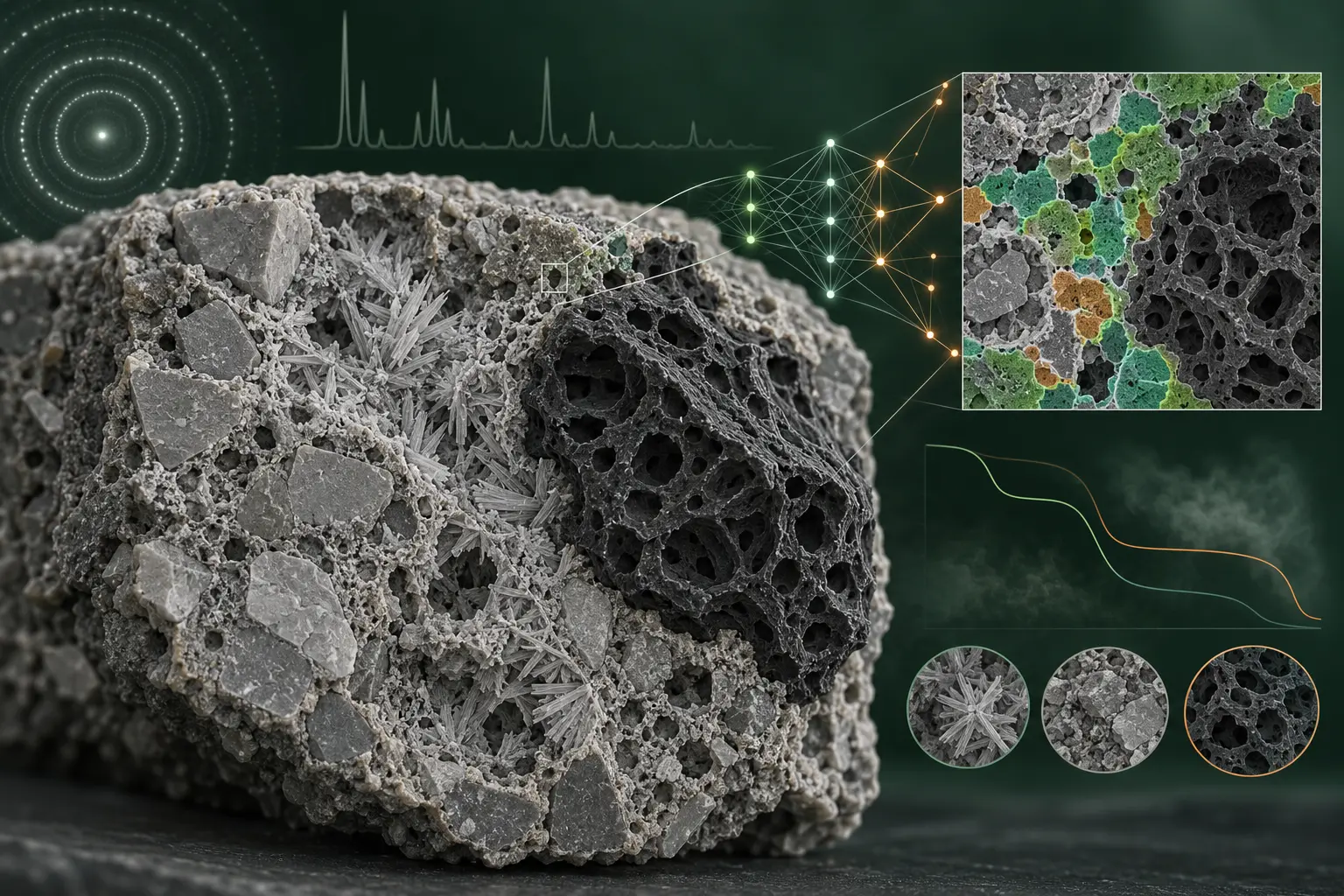
I am a PhD candidate in Civil and Architectural Engineering at the University of Miami, working in the SMARIN Lab under Dr. Xianming Shi. My work sits Between the materials laboratory and the computer, I study how cementitious systems behave when conventional constituents are replaced by supplementary and alternative materials, and I build computational models that make that behavior predictable. Experimentally, I work across fresh properties, mechanical performance, durability, and microstructure, using TGA, XRD, XRF, SEM-EDS, isothermal calorimetry, electrical resistivity and impedance spectroscopy, shrinkage, and leaching methods under ASTM, AASHTO, and ACI protocols. Computationally, I work in physics-informed and physics-constrained machine learning, Bayesian optimization for mixture design, graph and deep neural networks, and computer vision for microstructural image analysis. I am most interested in problems where neither the chemistry nor the algorithm is Sufficient on its own.
Research philosophy
My work follows a simple research logic: observe how a material behaves, explain that behavior with engineering science, and translate the evidence into models that remain useful beyond a single dataset.
I combine mechanical, durability, thermal, mineralogical, electrical, and microscopic measurements to determine how alternative constituents reshape cementitious systems.
I connect hydration, pore structure, age, and performance through constrained and uncertainty-aware learning, with particular attention to behavior outside the training domain.
I use prediction and optimization to support realistic decisions about mixture design, durability, embodied carbon, and cost while respecting material and specification limits.
Research agenda
Questions that connect sustainable construction materials with physically credible computation.
Internal curing, pore refinement, carbon storage, mechanical performance, and dimensional stability in biochar-blended mortar.
Hydration, phase assemblage, resistivity, transport, and durability of fly-ash and biochar mortars produced with alternative water and aggregate sources.
Hybrid learning frameworks that embed maturity, hydration, and engineering constraints to improve physical consistency and extrapolation.
Data-assisted concrete quality control and multi-objective mix design balancing strength, cost, and embodied carbon.
Reproducible analysis of cementitious microstructures using microscopy, phase mapping, and image segmentation.
In progress
Active experimental and computational work. Status labels distinguish projects from peer-reviewed publications.
Experimental study of strength, electrical response, shrinkage, hydration products, and contaminant immobilization across curing age.
Comparison of conventional regression, neural networks, and hard-constrained physics-informed models under interpolation and material-domain shift.
A multi-objective decision framework connecting early-age measurements with strength, cost, and embodied-carbon optimization.
Literature-derived modeling with source-aware validation to test whether strength models generalize to unseen studies.
Research outputs
Journal of Computing in Civil Engineering, 40(6), 04026084 · ASCE
doi:10.1061/JCCEE5.CPENG-7508AI in Civil Engineering, 4(1), 20 · Springer Nature
doi:10.1007/s43503-025-00064-8Scholarly communication
Peer-reviewed proceedings and accepted conference contributions.
Published
IEEE International Conference on Electrical, Computer and Communication Engineering (ECCE 2025)
doi:10.1109/ECCE64574.2025.11013991Published
28th International Conference on Computer and Information Technology (ICCIT 2025), IEEE
Published
28th International Conference on Computer and Information Technology (ICCIT 2025), IEEE
Published
28th International Conference on Computer and Information Technology (ICCIT 2025), IEEE
Published
27th International Conference on Computer and Information Technology (ICCIT 2024), IEEE
doi:10.1109/ICCIT64611.2024.11022574Accepted
16th IEEE International Conference on Computing, Communication and Networking Technologies (ICCCNT)
Accepted
7th International Conference on Advances in Civil Engineering (ICACE), CUET - [Springer]
Background
2026–present
SMARIN Lab, University of Miami
Experimental characterization of sustainable cementitious materials and development of physics-informed learning frameworks under Prof. Xianming Shi.
2026–present
University of Miami
Support for undergraduate civil engineering instruction, laboratory activities, assessment, and student learning.
2025
DebuggerLab
Developed, evaluated, and communicated machine-learning workflows for engineering applications.
January–June 2025
Sylhet Engineering College
Worked on experimental design, data preprocessing, and predictive modeling for concrete research.
2026–present
University of Miami
Coral Gables, Florida · Advisor: Prof. Xianming Shi
2020–2025
Sylhet Engineering College, Shahjalal University of Science and Technology
Sylhet, Bangladesh · CGPA: 3.40/4.00
Capabilities
Leadership
2024–2025
CE Center of Research
Led student research initiatives, seminars, workshops, and peer learning activities.
2024–2025
SEC Civil Society
Coordinated academic and professional-development activities for civil engineering students.
Research notes
Short notes on methods, evidence, reproducibility, and lessons from work in progress.
Why I am organizing my experimental, computational, and publication work in one transparent research record.
Read note →Contact
Open to research collaboration, scholarly exchange, and work connecting cementitious-material experiments with reliable data-driven methods.
Email Mayaz